From its opening minutes, Moves of the Diamond Hand is upfront about what it offers: You’re going to have a lot of strange conversations, and you’re going to roll a lot of dice. Get on board with this proposition, and the reward is one of the most creative roleplaying games I’ve seen in years, even if its many mysteries won’t be resolved until 2027.
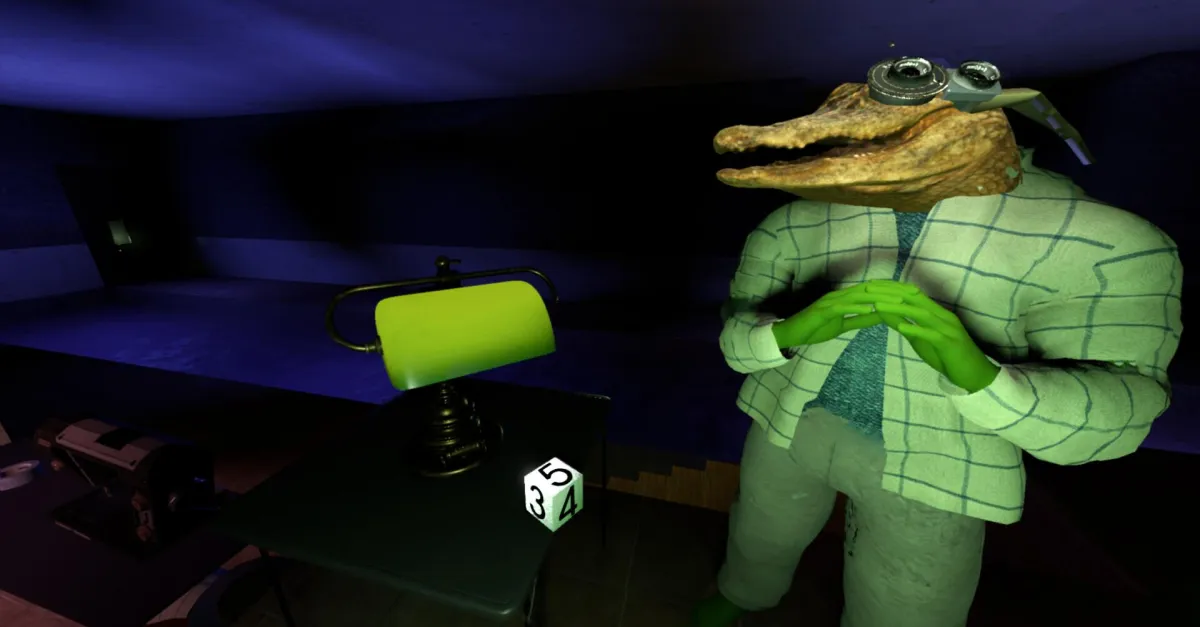
Moves of the Diamond Hand is an Early Access videogame available on PC, macOS, and steamOS (including the Steam Deck, where I played it) from musician and game designer Cosmo D. The game looks and feels like a 2000s-era first-person RPG or immersive sim: environments are grimy, stark, and blocky; characters’ features are stretched over smooth heads a bit too small for their faces; an eerie soundtrack pulses over all. You’ll arrive on a train and immediately meet an old mentor, disgraced by some kind of political scandal. You convey your desire to join a powerful organization called Circus X, then declare which of several wildly different paths you’ll take into its fold — you can try joining the city council, but could find equal success crafting the perfect sandwich or joining the best band.
These options help introduce the central mechanic. The game gives you one upgradeable die for each of seven stats, ranging from standard fare like Physique and Observation to the more idiosyncratic Cooking and Music. To set a challenge, it will roll a die corresponding to one of those attributes, and you’ve got to match or beat it with your own roll.
Once you emerge into the train station, the complexity quickly multiplies. There are a plethora of sub-mechanics including cooking, performing music, laundering disguises, and mixing cocktails — all of which add additional dice with unique quirks. You can selectively re-roll dice in a manner similar to Yahtzee, introducing an element of strategy within each encounter, and your final score (win or lose) is translated into experience points. The basic system was introduced in Cosmo D’s last game, Betrayal at Club Low, but in a less flexible and elegant form; Diamond Hand feels like its evolution. (Disclosure: My husband has provided outside feedback for Cosmo D’s games.)
It’s all a little intimidating at first. But the game allows you to ease into its options, which happens quickly, since you’re rolling for virtually every action and verbal exchange from making small talk to opening a door. There’s a meaningful element of chance to all this, without descending into unbounded randomness. Some rolls can be mathematically impossible to win or lose at a given skill level, but it’s possible to still damage your health or gain an unwelcome status effect with safe challenges, preventing them from becoming purely rote. You can retry most actions if you fail them, but they’ll become slightly more difficult on a second attempt, so there’s a constant balancing act of deciding when to take the initial leap. The ambient low-level risk makes even simple spaces feel substantive and engaging — it negates the common RPG urge to speed through environmental detail and flavor text while looking for the “real” parts of the game.
Through countless skill checks, you’ll internalize the odd logic of the game’s world. The setting, Off-Peak City, is a garish metropolis shaped by the machinations of sinister corporations, corrupt politicians, and shady operatives, but also musicians, restaurateurs, and literally and figuratively underground tailors — a neon retro-future for streetwise aesthetes. What might be niche skills in any other game prove extraordinarily powerful here. The Music stat, whose uses include sewing (machines can, among other options, be literally operated by improvisation), calming aggressive animal-human hybrids (by whistling tunes), and mixology (which can be performed “rhythmically”), is arguably the single strongest power in the game.

Circus X, you’ll soon learn, is a secretive arts institution that influences everything from politics to the sandwich supply chain — imagine the Factory crossed with the Freemasons. While pursuing membership, you’re embroiled in a local election between a scandal-plagued technocrat, a former boy-band star, and the corporate-controlled clone of a mayor from decades past. In place of a Maltese Falcon, everyone’s scheming for control of a sentient Big Mouth Billy Bass. And meddling behind the scenes is the mysterious, anarchic Diamond Hand, frequently alluded to but not explained.
Diamond Hand’s story evokes real-world parallels, but as a jumping-off point for something that’s rich and alive in its own right. In perhaps the most obvious example, a company in Off-Peak City is pumping the place full of clones, supplanting human artists with corporate-guardrailed regurgitations of old media. But rather than stop at commentary, the game walks this out to explore the idea that clones are also conscious beings who are frustrated by their creative limits and lack of autonomy, while letting human characters reflect on their own relationship with nostalgia and artistic taste.
Put this all together and you’ve got a hard-boiled sci-fi thriller involving subway busking, finding library books, stumping for politicians, harvesting lettuce, arguing about jazz, and doing laundry, infused with the lizard-brain appeal of a nonstop game of chance. It’s irresistible.
Most of Diamond Hand’s main quests end in roadblocks, because its Early Access build includes only the first two of six chapters, with the next scheduled for this summer and a full launch set for the spring of 2027. But even in its current state, Diamond Hand is dense and tantalizing, delivering a string of absurd premises and dry humor with a straight face. (Among many tossed-off jokes that are also actual game mechanics, local pizza-makers require everyone to bake their own pie, so if you don’t like your order, you have only yourself to blame.) You’re granted experience points for letting characters ramble through their backstories and opinions — which lands somewhere between a sly gag about RPG infodumping and a straightforwardly clever decision — but the dialogue pays off even without that prize.
And for all its dystopian elements, there’s something idealistic about a world where art, for good or ill, deeply matters. Diamond Hand may be a work in progress, but it’s a recipe for becoming obsessed with skill and perfection, chasing the world’s greatest sandwich and the string of lucky dice rolls that will get you there.